
Maulana Bhasani on Nonviolence, Violence and Politics

MGSHSS

to

Faculty Lounge VC Office LUMS

Speaker: Md Mizanur Rahman (LUMS)


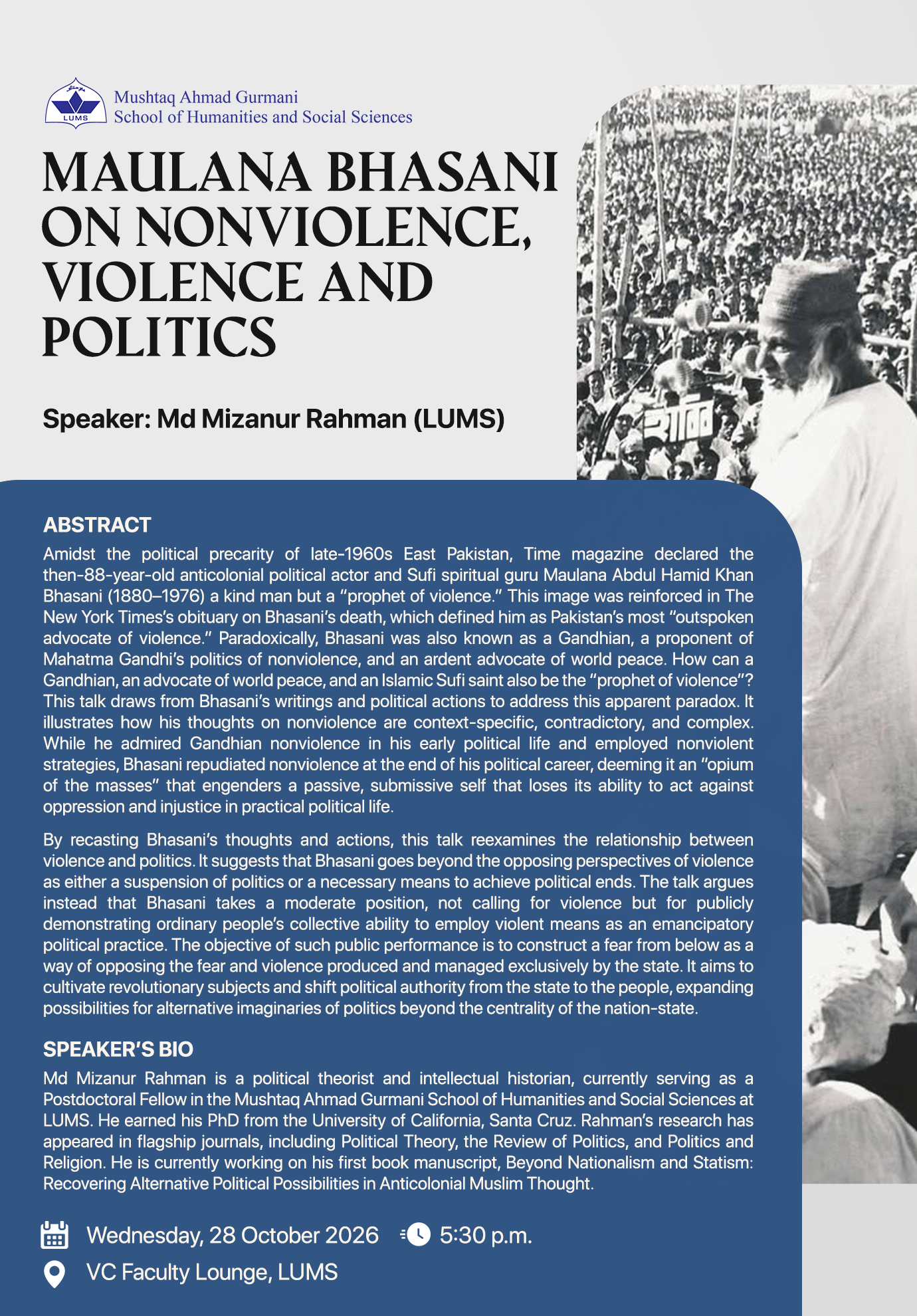
Abstract: Amidst the political precarity of late-1960s East Pakistan, Time magazine declared the then-88-year-old anticolonial political actor and Sufi spiritual guru Maulana Abdul Hamid Khan Bhasani (1880–1976) a kind man but a “prophet of violence.” This image was reinforced in The New York Times’s obituary on Bhasani’s death, which defined him as Pakistan’s most “outspoken advocate of violence.” Paradoxically, Bhasani was also known as a Gandhian, a proponent of Mahatma Gandhi’s politics of nonviolence, and an ardent advocate of world peace. How can a Gandhian, an advocate of world peace, and an Islamic Sufi saint also be the “prophet of violence”? This talk draws from Bhasani’s writings and political actions to address this apparent paradox. It illustrates how his thoughts on nonviolence are context-specific, contradictory, and complex. While he admired Gandhian nonviolence in his early political life and employed nonviolent strategies, Bhasani repudiated nonviolence at the end of his political career, deeming it an “opium of the masses” that engenders a passive, submissive self that loses its ability to act against oppression and injustice in practical political life. By recasting Bhasani’s thoughts and actions, this talk reexamines the relationship between violence and politics. It suggests that Bhasani goes beyond the opposing perspectives of violence as either a suspension of politics or a necessary means to achieve political ends. The talk argues instead that Bhasani takes a moderate position, not calling for violence but for publicly demonstrating ordinary people’s collective ability to employ violent means as an emancipatory political practice. The objective of such public performance is to construct a fear from below as a way of opposing the fear and violence produced and managed exclusively by the state. It aims to cultivate revolutionary subjects and shift political authority from the state to the people, expanding possibilities for alternative imaginaries of politics beyond the centrality of the nation-state.


Bio:

Md Mizanur Rahman is a political theorist and intellectual historian, currently serving as a Postdoctoral Fellow in the Mushtaq Ahmad Gurmani School of Humanities and Social Sciences at LUMS. He earned his PhD from the University of California, Santa Cruz. Rahman’s research has appeared in flagship journals, including Political Theory, the Review of Politics, and Politics and Religion. He is currently working on his first book manuscript, Beyond Nationalism and Statism: Recovering Alternative Political Possibilities in Anticolonial Muslim Thought.
 

MGSHSS

Add to Calendar 2026-10-28 17:30:57 2026-10-28 19:30:57 Maulana Bhasani on Nonviolence, Violence and Politics Speaker: Md Mizanur Rahman (LUMS) Abstract: Amidst the political precarity of late-1960s East Pakistan, Time magazine declared the then-88-year-old anticolonial political actor and Sufi spiritual guru Maulana Abdul Hamid Khan Bhasani (1880–1976) a kind man but a “prophet of violence.” This image was reinforced in The New York Times’s obituary on Bhasani’s death, which defined him as Pakistan’s most “outspoken advocate of violence.” Paradoxically, Bhasani was also known as a Gandhian, a proponent of Mahatma Gandhi’s politics of nonviolence, and an ardent advocate of world peace. How can a Gandhian, an advocate of world peace, and an Islamic Sufi saint also be the “prophet of violence”? This talk draws from Bhasani’s writings and political actions to address this apparent paradox. It illustrates how his thoughts on nonviolence are context-specific, contradictory, and complex. While he admired Gandhian nonviolence in his early political life and employed nonviolent strategies, Bhasani repudiated nonviolence at the end of his political career, deeming it an “opium of the masses” that engenders a passive, submissive self that loses its ability to act against oppression and injustice in practical political life. By recasting Bhasani’s thoughts and actions, this talk reexamines the relationship between violence and politics. It suggests that Bhasani goes beyond the opposing perspectives of violence as either a suspension of politics or a necessary means to achieve political ends. The talk argues instead that Bhasani takes a moderate position, not calling for violence but for publicly demonstrating ordinary people’s collective ability to employ violent means as an emancipatory political practice. The objective of such public performance is to construct a fear from below as a way of opposing the fear and violence produced and managed exclusively by the state. It aims to cultivate revolutionary subjects and shift political authority from the state to the people, expanding possibilities for alternative imaginaries of politics beyond the centrality of the nation-state. Bio:Md Mizanur Rahman is a political theorist and intellectual historian, currently serving as a Postdoctoral Fellow in the Mushtaq Ahmad Gurmani School of Humanities and Social Sciences at LUMS. He earned his PhD from the University of California, Santa Cruz. Rahman’s research has appeared in flagship journals, including Political Theory, the Review of Politics, and Politics and Religion. He is currently working on his first book manuscript, Beyond Nationalism and Statism: Recovering Alternative Political Possibilities in Anticolonial Muslim Thought.  Faculty Lounge VC Office LUMS LUMS Drupal 8 adil.sarwar@lums.edu.pk Asia/Karachi public
Upcoming Events

Events Calendar