
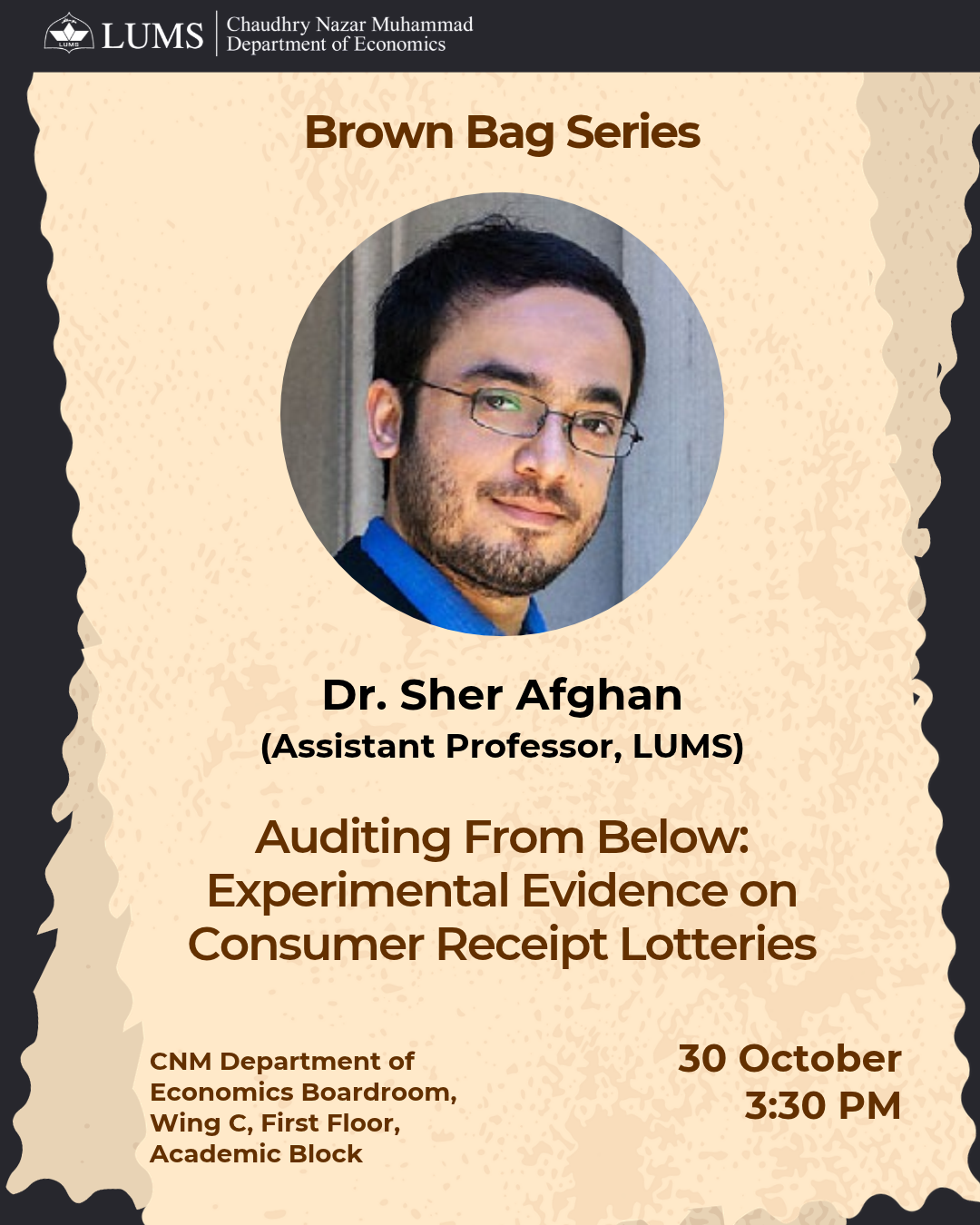
Brown Bag Series | Auditing from Below: Experimental Evidence on Consumer Receipt Lotteries

MGSHSS

to

CNM Department of Economics Boardroom, Wing C, First Floor, Academic Block

The Chaudhry Nazar Muhammad Department of Economics is pleased to invite you to the Brown Bag Talk by Dr. Sher Afghan Asad, Assistant Professor in the CNM Department of Economics on Friday 30th October 2026, at 3:30 PM in the CNM Department of Economics Boardroom, Wing C, First Floor, Academic Block 

Dr. Asad will present his talk on "Auditing from Below: Experimental Evidence on Consumer Receipt Lotteries"


If anyone would like to join online, please use the Zoom link below.

https://lums-edu-pk.zoom.us/j/96797122751?pwd=XpaY1cQ01dAL2uB1fzgFOKdGkI7akV.1

Meeting ID: 967 9712 2751
Passcode: 788417


Abstract: Tax authorities with little enforcement capacity increasingly enlist consumers to monitor firms, most often through receipt lotteries. In three randomized experiments with a provincial tax authority in Pakistan, we study, among registered restaurants and hotels, how a lottery changes firms' reporting and beliefs, why consumers take part, and how consumer monitoring interacts with the state's own enforcement. Consumers took part, responded to reminders, and many cited civic reasons. Many of their receipts appear to record sales missing from the authority's records. Yet firms' declarations, beliefs about detection, and views of the authority did not change detectably. Officers acted on few receipts. Consumers are also parties to the sale, and, suggestively, firms came to expect customers to ask for discounts in exchange for foregoing receipts. The authority's own enforcement letter raised the use of point-of-sale devices among the lottery's control firms but had no detectable effect among lottery firms, suggesting that, among these firms, consumer monitoring substituted for the authority's enforcement. Where the authority lacks the capacity to act on what consumers send, enlisting them need not raise compliance.


Speaker: Dr. Sher Afghan Asad is an applied microeconomist studying the behavioral foundations of markets and state capacity. He is an Assistant Professor of Economics at LUMS, an Abdul Latif Jameel Poverty Action Lab (J-PAL) invited researcher, a research affiliate at the International Growth Centre (IGC), and an approved Principal Investigator for the Weiss Fund for Research in Development Economics. His research has been published in the Journal of Development Economics and the Journal of Economic Behavior & Organization. His work has been supported by grants from the IGC, PEDL, J-PAL, the Weiss Fund, the World Bank, and the Russell Sage Foundation.
 

MGSHSS
Add to Calendar 2026-10-30 15:30:41 2026-10-30 16:30:41 Brown Bag Series | Auditing from Below: Experimental Evidence on Consumer Receipt Lotteries The Chaudhry Nazar Muhammad Department of Economics is pleased to invite you to the Brown Bag Talk by Dr. Sher Afghan Asad, Assistant Professor in the CNM Department of Economics on Friday 30th October 2026, at 3:30 PM in the CNM Department of Economics Boardroom, Wing C, First Floor, Academic Block Dr. Asad will present his talk on "Auditing from Below: Experimental Evidence on Consumer Receipt Lotteries" If anyone would like to join online, please use the Zoom link below.https://lums-edu-pk.zoom.us/j/96797122751?pwd=XpaY1cQ01dAL2uB1fzgFOKdGkI7akV.1Meeting ID: 967 9712 2751Passcode: 788417 Abstract: Tax authorities with little enforcement capacity increasingly enlist consumers to monitor firms, most often through receipt lotteries. In three randomized experiments with a provincial tax authority in Pakistan, we study, among registered restaurants and hotels, how a lottery changes firms' reporting and beliefs, why consumers take part, and how consumer monitoring interacts with the state's own enforcement. Consumers took part, responded to reminders, and many cited civic reasons. Many of their receipts appear to record sales missing from the authority's records. Yet firms' declarations, beliefs about detection, and views of the authority did not change detectably. Officers acted on few receipts. Consumers are also parties to the sale, and, suggestively, firms came to expect customers to ask for discounts in exchange for foregoing receipts. The authority's own enforcement letter raised the use of point-of-sale devices among the lottery's control firms but had no detectable effect among lottery firms, suggesting that, among these firms, consumer monitoring substituted for the authority's enforcement. Where the authority lacks the capacity to act on what consumers send, enlisting them need not raise compliance. Speaker: Dr. Sher Afghan Asad is an applied microeconomist studying the behavioral foundations of markets and state capacity. He is an Assistant Professor of Economics at LUMS, an Abdul Latif Jameel Poverty Action Lab (J-PAL) invited researcher, a research affiliate at the International Growth Centre (IGC), and an approved Principal Investigator for the Weiss Fund for Research in Development Economics. His research has been published in the Journal of Development Economics and the Journal of Economic Behavior & Organization. His work has been supported by grants from the IGC, PEDL, J-PAL, the Weiss Fund, the World Bank, and the Russell Sage Foundation.  CNM Department of Economics Boardroom, Wing C, First Floor, Academic Block LUMS Drupal 8 adil.sarwar@lums.edu.pk Asia/Karachi public

Upcoming Events

Events Calendar