

Lineages of the ‘Everywhere and Nowhere State’: Frontier Governance and (early) Postcolonial State Development

MGSHSS

to

Faculty Lounge VC Office LUMS

Abstract

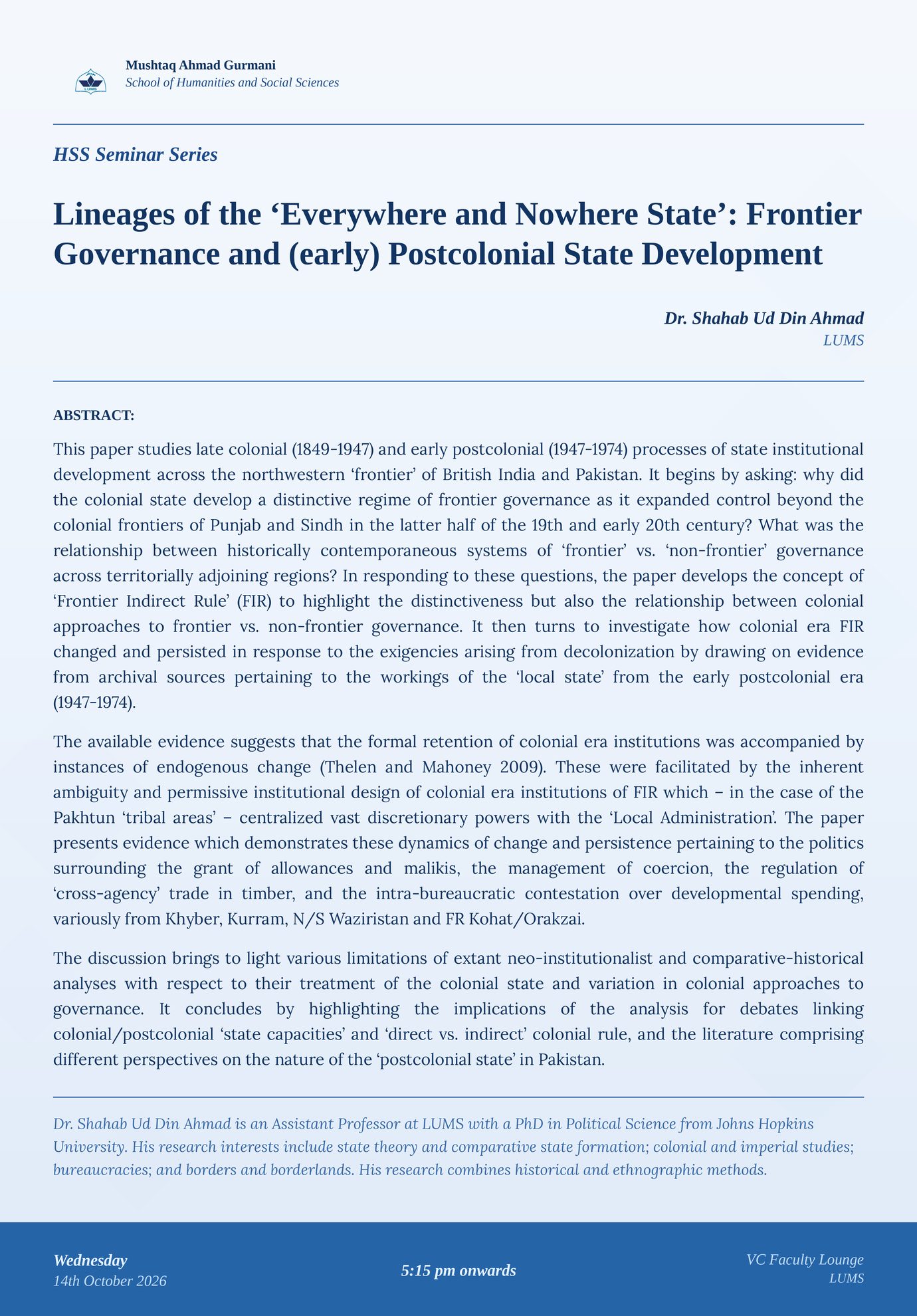
This paper studies late colonial (1849-1947) and early postcolonial (1947-1974) processes of state institutional development across the northwestern ‘frontier’ of British India and Pakistan. It begins by asking: why did the colonial state in India develop a distinctive regime of frontier governance as it expanded control beyond the colonial frontiers of Punjab and Sindh in the latter half of the 19th and early 20th century? What was the relationship between historically contemporaneous systems of ‘frontier’ vs. ‘non-frontier’ governance across territorially adjoining regions? In responding to these questions, the paper develops the concept of ‘Frontier Indirect Rule’ (FIR) to highlight the distinctiveness but also the relationship between colonial approaches to frontier vs. non-frontier governance. It then turns to investigate how colonial era FIR changed and persisted in response to the exigencies arising from decolonization by drawing on evidence from archival sources pertaining to the workings of the ‘local state’ (Provincial and ‘Agency’ level records) from the early postcolonial era (1947-1974).


The available evidence suggests that the formal retention of colonial era institutions was accompanied by instances of endogenous change (Thelen and Mahoney 2009). These were facilitated by the inherent ambiguity and permissive institutional design of colonial era institutions of FIR which - in the case of the Pakhtun ‘tribal areas’ - centralized vast discretionary powers with the ‘Local Administration’. The paper presents evidence which demonstrates these dynamics of change and persistence pertaining to the politics surrounding the grant of allowances and malikis, the management of coercion, the regulation of ‘cross-agency’ trade in timber, and the intra-bureaucratic contestation over developmental spending, variously from Khyber, Kurram, N/S Waziristan and FR Kohat/Orakzai.


The discussion brings to light various limitations of extant neo-institutionalist and comparative-historical analyses (AJR 2001; Iyer and Banerjee 2005; Iyer 2010; Lange 2010; Gerring et al. 2011; Mahoney 2011; Naseemullah and Staniland 2014; Naseemullah 2022) with respect to their treatment of the colonial state and variation in colonial approaches to governance.  It concludes by highlighting the implications of the analysis for debates linking colonial/postcolonial ‘state capacities’ and ‘direct vs. indirect’ colonial rule (AJR 2001; Kohli 2004; Lange 2010; Mahoney 2011;), and the literature comprising different perspectives on the nature of the ‘postcolonial state’ in Pakistan within the political economy tradition (Alavi 1972; Zaidi 2014; Akhtar 2018; Zaidi and McCartney 2019).


Bio: 

Dr. Shahab Ud Din Ahmad is an Assistant Professor at LUMS and has a PhD in Political Science from Johns Hopkins. His research interests include state theory and comparative state formation; colonial and imperial studies; bureaucracies; and borders and borderlands. His research combines historical and ethnographic methods. He is interested in methodological questions regarding the use of history for social science analyses.
 

MGSHSS


Add to Calendar 2026-10-14 17:15:37 2026-10-14 19:00:37 Lineages of the ‘Everywhere and Nowhere State’: Frontier Governance and (early) Postcolonial State Development AbstractThis paper studies late colonial (1849-1947) and early postcolonial (1947-1974) processes of state institutional development across the northwestern ‘frontier’ of British India and Pakistan. It begins by asking: why did the colonial state in India develop a distinctive regime of frontier governance as it expanded control beyond the colonial frontiers of Punjab and Sindh in the latter half of the 19th and early 20th century? What was the relationship between historically contemporaneous systems of ‘frontier’ vs. ‘non-frontier’ governance across territorially adjoining regions? In responding to these questions, the paper develops the concept of ‘Frontier Indirect Rule’ (FIR) to highlight the distinctiveness but also the relationship between colonial approaches to frontier vs. non-frontier governance. It then turns to investigate how colonial era FIR changed and persisted in response to the exigencies arising from decolonization by drawing on evidence from archival sources pertaining to the workings of the ‘local state’ (Provincial and ‘Agency’ level records) from the early postcolonial era (1947-1974). The available evidence suggests that the formal retention of colonial era institutions was accompanied by instances of endogenous change (Thelen and Mahoney 2009). These were facilitated by the inherent ambiguity and permissive institutional design of colonial era institutions of FIR which - in the case of the Pakhtun ‘tribal areas’ - centralized vast discretionary powers with the ‘Local Administration’. The paper presents evidence which demonstrates these dynamics of change and persistence pertaining to the politics surrounding the grant of allowances and malikis, the management of coercion, the regulation of ‘cross-agency’ trade in timber, and the intra-bureaucratic contestation over developmental spending, variously from Khyber, Kurram, N/S Waziristan and FR Kohat/Orakzai. The discussion brings to light various limitations of extant neo-institutionalist and comparative-historical analyses (AJR 2001; Iyer and Banerjee 2005; Iyer 2010; Lange 2010; Gerring et al. 2011; Mahoney 2011; Naseemullah and Staniland 2014; Naseemullah 2022) with respect to their treatment of the colonial state and variation in colonial approaches to governance.  It concludes by highlighting the implications of the analysis for debates linking colonial/postcolonial ‘state capacities’ and ‘direct vs. indirect’ colonial rule (AJR 2001; Kohli 2004; Lange 2010; Mahoney 2011;), and the literature comprising different perspectives on the nature of the ‘postcolonial state’ in Pakistan within the political economy tradition (Alavi 1972; Zaidi 2014; Akhtar 2018; Zaidi and McCartney 2019). Bio: Dr. Shahab Ud Din Ahmad is an Assistant Professor at LUMS and has a PhD in Political Science from Johns Hopkins. His research interests include state theory and comparative state formation; colonial and imperial studies; bureaucracies; and borders and borderlands. His research combines historical and ethnographic methods. He is interested in methodological questions regarding the use of history for social science analyses.   Faculty Lounge VC Office LUMS LUMS Drupal 8 adil.sarwar@lums.edu.pk Asia/Karachi public
Upcoming Events

Events Calendar