


to
CNM Department of Economics Boardroom, Wing C, First Floor, Academic Block
ujala.riaz@lums.edu.pk
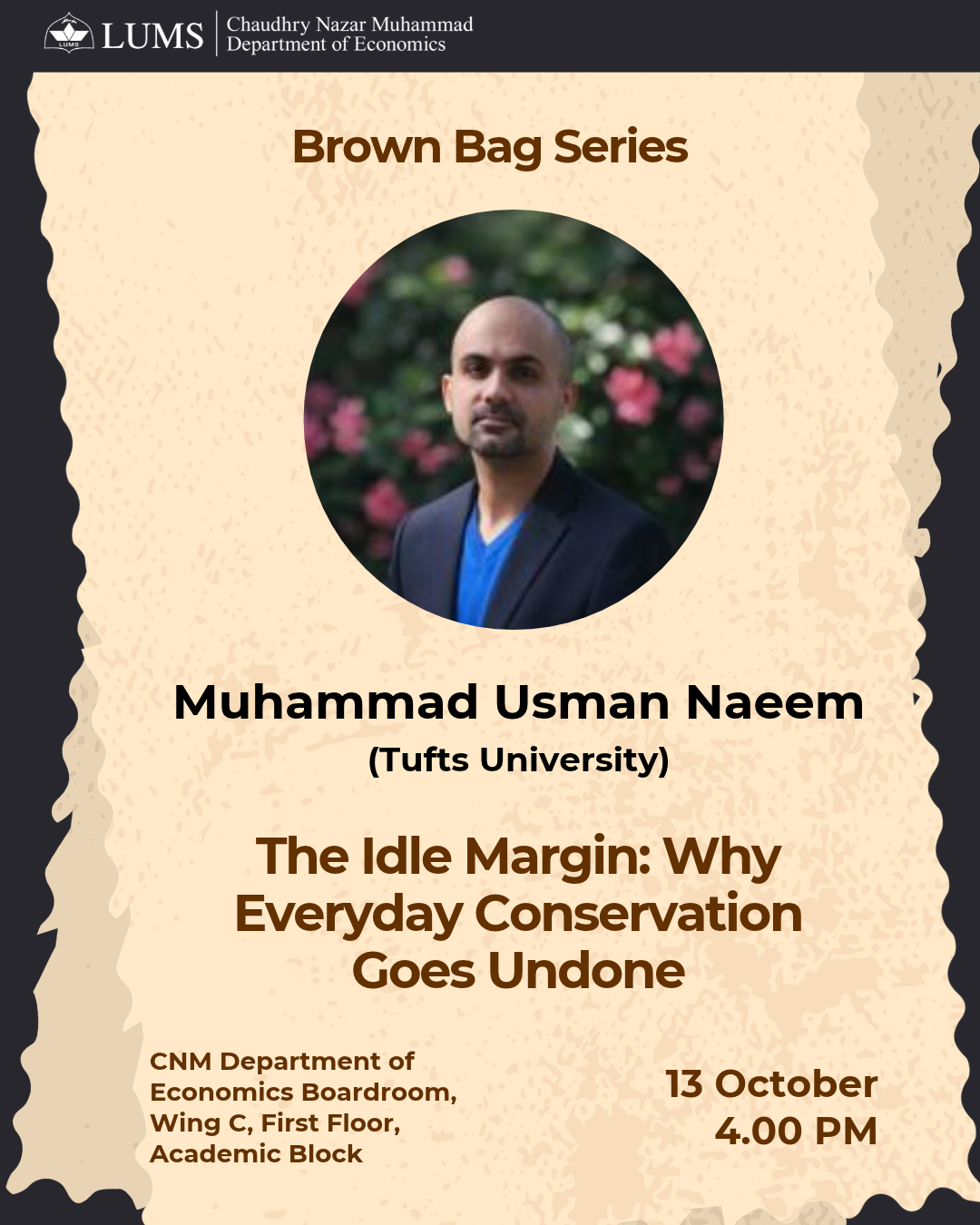
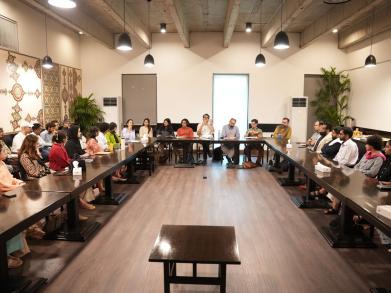
The Chaudhry Nazar Muhammad Department of Economics is pleased to invite you to the Brown Bag Talk by Muhammad Usman Naeem on Tuesday 13th October 2026, at 4:00 PM in the CNM Department of Economics Boardroom, Wing C, First Floor, Academic Block
Mr. Usman will present his talk on "The Idle Margin: Why Everyday Conservation Goes Undone."
If anyone would like to join online, please use the Zoom link below.
https://lums-edu-pk.zoom.us/j/95857081078?pwd=Pvbzc1VmwtVIPW8KXB3Y0T9MCaSybP.1
Meeting ID: 958 5708 1078
Passcode: 360609
Abstract :Vehicle idling—leaving the engine running while stopped—poses a recurring conservation puzzle: for sufficiently long stops, switching off saves drivers money on fuel while reducing emissions, so private and social incentives point in the same direction. Why, then, do drivers persist in idling? In partnership with a leading telematics firm in Pakistan, I collect 10-second GPS data on ignition status, speed, and location from 6,621 private vehicles. The average vehicle idles for 27 minutes per observed day. At baseline, drivers hold widespread misperceptions about whether warming up an engine extends engine life and how long a stop must last before shutting off saves fuel or reduces environmental harm. I use a randomised additive design varying private information, social information, payments, and an in-car reminder technology. Private information reduces daily idling from stops longer than 30 seconds by 1.8 minutes, or 9% of the control mean, and the effect persists after treatment ends. Estimated benefits are 3.7 times programme costs over the eight-week intervention, wi
th about half accruing directly to drivers through fuel savings. Adding either social information or payments produces no detectable additional reduction. By contrast, activating the reminder device increases idling by 1.0 minute, with the increase concentrated in long spells—a pattern consistent with procrastination. The results show that idling is a meaningful behavioural margin that can be changed, but also that interventions designed to reduce it can backfire.
Speaker: Muhammad Usman Naeem is a PhD candidate in Economics & Public Policy at Tufts University. His research combines development, environmental, and behavioural economics to study pollution and energy in developing economies, using field experiments and new forms of measurement to understand hard-to-observe behaviour and policy effectiveness. He was previously Country Economist for Pakistan at the International Growth Centre and a Visiting Fellow in the Harvard University Department of Economics.