

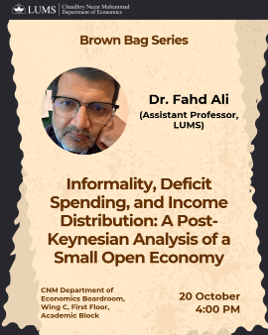
Brown Bag Series | Informality, Deficit Spending, and Income Distribution: A Post-Keynesian Analysis of a Small Open Economy

MGSHSS

to

CNM Department of Economics Boardroom, Wing C, First Floor, Academic Block

The Chaudhry Nazar Muhammad Department of Economics is pleased to invite you to the Brown Bag Talk by Dr. Fahd Ali, Assistant Professor in the CNM Department of Economics on Tuesday 20th October 2026, at 4:00 PM in the CNM Department of Economics Boardroom, Wing C, First Floor, Academic Block 

Dr. Ali will present his talk on "Informality, Deficit Spending, and Income Distribution: A Post-Keynesian Analysis of a Small Open Economy"


If anyone would like to join online, please use the Zoom link below.

https://lums-edu-pk.zoom.us/j/96134032431?pwd=X4AsOXCBc4jASHOKb6g9aF42OiZZ3O.1

Meeting ID: 961 3403 2431
Passcode: 040915


Speaker: Dr. Fahd Ali did his PhD in Economics from The New School for Social Research. He also has an undergraduate degree in Mechanical Engineering from Ghulam Ishaq Khan Institute of Engineering Sciences and Technology, and two Masters in Economics from Lahore University of Management Sciences and University of Utah, respectively. His research interests lie in macroeconomics and economic history with political economy as theme common to both. His work has appeared in Economic and Political Weekly and Canadian Journal of Development Studies. 

He studied at University of Utah and the New School for Social Research on Fulbright Scholarship. He received the Frieda Wunderlich Memorial Award for Outstanding Dissertation by an International Student for his dissertation, Resource Mobilization through Taxation: The political economy of state and society in Pakistan. He was one of thirteen recipients of the 2016 New School for Social Research Commencement Award. This is the highest honor the school can bestow on its best Ph.D. graduates.


Abstract: We develop a two-sector Kaleckian model of a small open economy, motivated by Pakistan, in which informality is defined by non-payment of taxes. Formal and informal firms set prices as markups over labour and imported-input costs, with informal wages a fixed fraction of formal wages. Distribution is measured in value added, so wage shares follow Kalecki’s formula, falling with markups and with imported-material costs relative to wages. Formalisation is endogenous, falling with taxes on capitalists and rising with financial deepening. Beyond a critical tax rate, deficit spending reduces financial deepening as informal receipts leak from the banking system. A price-consistent goods-market equilibrium treats imported inputs as a leakage and includes remittances and domestic and foreign public debt. It shows that deficit spending, aid and remittances raise formal-sector utilisation, while larger debt stocks reduce it through the interest channel. Inflation is driven by wage growth and exchange-rate depreciation, weighted by import-cost shares. A modified Marshall–Lerner condition shows that intermediate imports raise the hurdle for depreciation to improve the trade balance. Remittance inflows appreciate the currency and contract formal exports, raising the formal wage share while shrinking the formal wage bill, unless spending out of remittances dominates.
Econ
Add to Calendar 2026-10-20 16:00:42 2026-10-20 11:32:42 Brown Bag Series | Informality, Deficit Spending, and Income Distribution: A Post-Keynesian Analysis of a Small Open Economy The Chaudhry Nazar Muhammad Department of Economics is pleased to invite you to the Brown Bag Talk by Dr. Fahd Ali, Assistant Professor in the CNM Department of Economics on Tuesday 20th October 2026, at 4:00 PM in the CNM Department of Economics Boardroom, Wing C, First Floor, Academic Block Dr. Ali will present his talk on "Informality, Deficit Spending, and Income Distribution: A Post-Keynesian Analysis of a Small Open Economy" If anyone would like to join online, please use the Zoom link below.https://lums-edu-pk.zoom.us/j/96134032431?pwd=X4AsOXCBc4jASHOKb6g9aF42OiZZ3O.1Meeting ID: 961 3403 2431Passcode: 040915 Speaker: Dr. Fahd Ali did his PhD in Economics from The New School for Social Research. He also has an undergraduate degree in Mechanical Engineering from Ghulam Ishaq Khan Institute of Engineering Sciences and Technology, and two Masters in Economics from Lahore University of Management Sciences and University of Utah, respectively. His research interests lie in macroeconomics and economic history with political economy as theme common to both. His work has appeared in Economic and Political Weekly and Canadian Journal of Development Studies. He studied at University of Utah and the New School for Social Research on Fulbright Scholarship. He received the Frieda Wunderlich Memorial Award for Outstanding Dissertation by an International Student for his dissertation, Resource Mobilization through Taxation: The political economy of state and society in Pakistan. He was one of thirteen recipients of the 2016 New School for Social Research Commencement Award. This is the highest honor the school can bestow on its best Ph.D. graduates. Abstract: We develop a two-sector Kaleckian model of a small open economy, motivated by Pakistan, in which informality is defined by non-payment of taxes. Formal and informal firms set prices as markups over labour and imported-input costs, with informal wages a fixed fraction of formal wages. Distribution is measured in value added, so wage shares follow Kalecki’s formula, falling with markups and with imported-material costs relative to wages. Formalisation is endogenous, falling with taxes on capitalists and rising with financial deepening. Beyond a critical tax rate, deficit spending reduces financial deepening as informal receipts leak from the banking system. A price-consistent goods-market equilibrium treats imported inputs as a leakage and includes remittances and domestic and foreign public debt. It shows that deficit spending, aid and remittances raise formal-sector utilisation, while larger debt stocks reduce it through the interest channel. Inflation is driven by wage growth and exchange-rate depreciation, weighted by import-cost shares. A modified Marshall–Lerner condition shows that intermediate imports raise the hurdle for depreciation to improve the trade balance. Remittance inflows appreciate the currency and contract formal exports, raising the formal wage share while shrinking the formal wage bill, unless spending out of remittances dominates. CNM Department of Economics Boardroom, Wing C, First Floor, Academic Block LUMS Drupal 8 adil.sarwar@lums.edu.pk Asia/Karachi public

Upcoming Events

Events Calendar