


to
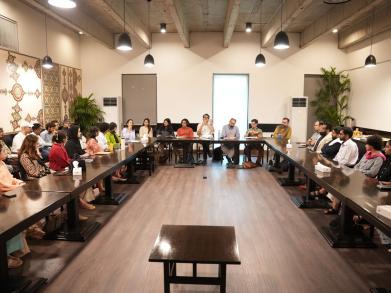
Faculty Lounge VC Office LUMS
fahid.ahmad@lums.edu.pk
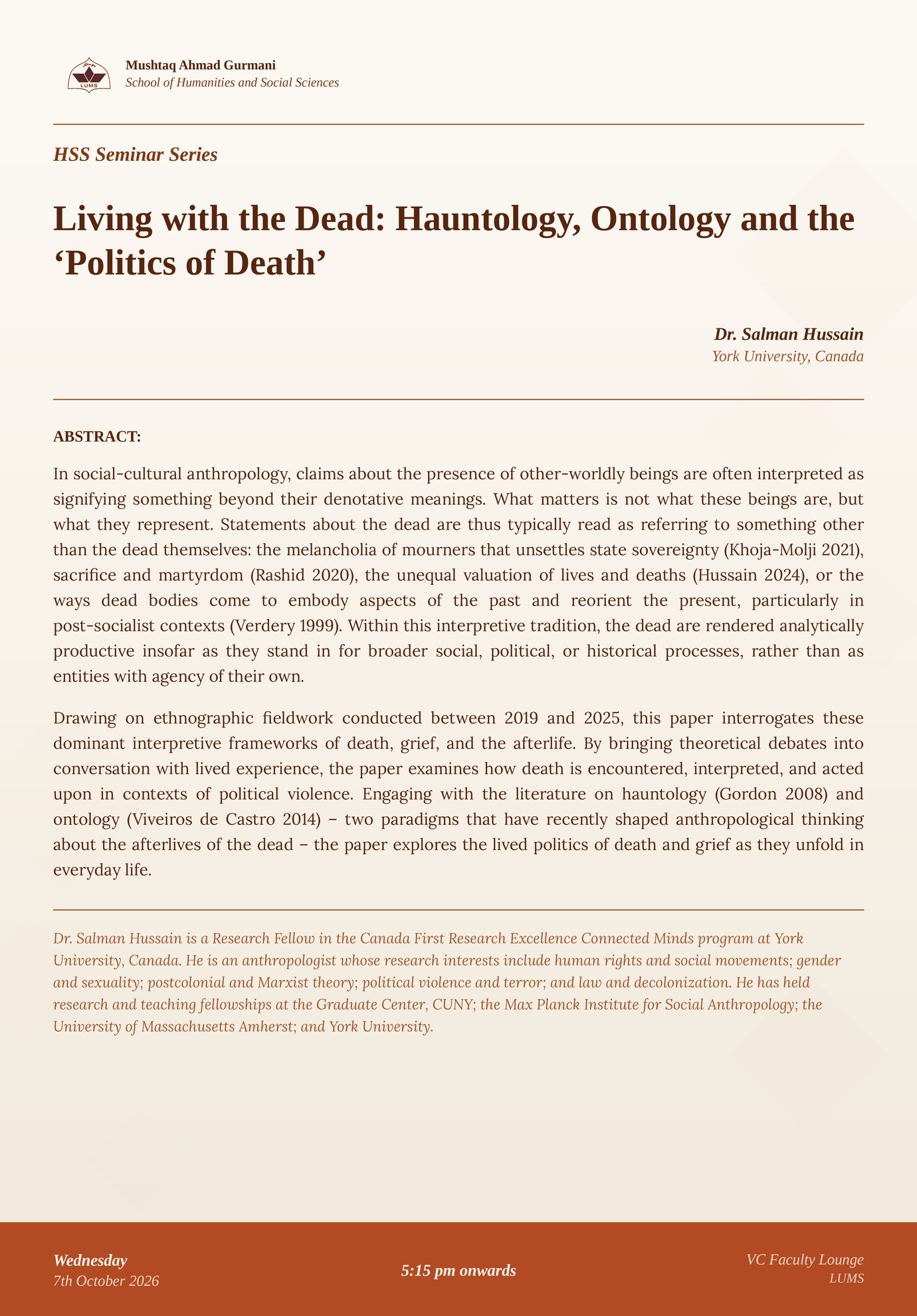
Abstract: In social-cultural anthropology, claims about the presence of other-worldly beings are often interpreted as signifying something beyond their denotative meanings. What matters is not what these beings are, but what they represent. Statements about the dead are thus typically read as referring to something other than the dead themselves: the melancholia of mourners that unsettles state sovereignty (Khoja-Molji 2021), sacrifice and martyrdom (Rashid 2020), the unequal valuation of lives and deaths (Hussain 2024), or the ways dead bodies come to embody aspects of the past and reorient the present, particularly in post-socialist contexts (Verdery 1999). Within this interpretive tradition, the dead are rendered analytically productive insofar as they stand in for broader social, political, or historical processes, rather than as entities with agency of their own.
Drawing on ethnographic fieldwork conducted between 2019-2025, this paper interrogates these dominant interpretive frameworks of death, grief, and the afterlife. By bringing theoretical debates into conversation with lived experience, the paper examines how death is encountered, interpreted, and acted upon in contexts of political violence. Engaging with the literature on hauntology (Gordon 2008) and ontology (Viveiros de Castro 2014) – two paradigms that have recently shaped anthropological thinking about the afterlives of the dead – the paper explores the lived politics of death and grief as they unfold in everyday life.
Bio: Dr. Salman Hussain is a Research Fellow in the Canada First Research Excellence Connected Minds program at York University, Canada. He is an anthropologist whose research interests include human rights and social movements; gender and sexuality; postcolonial and Marxist theory; political violence and terror; and law and decolonization. He has held research and teaching fellowships at the Graduate Center, CUNY; the Max Planck Institute for Social Anthropology; the University of Massachusetts Amherst; and York University.